

DCOCO
Collection
3 items • Updated • 1
This repository contains the DCOCO (DFlash Contextual Corrector) speculative-decoding drafter
for Qwen/Qwen3-8B, from the paper Contextual Correction of
Parallel Drafts for Speculative Decoding. It is a draft model: serve it together with
Qwen/Qwen3-8B, which verifies every token, so the output distribution is exactly the target model's.
Paper: Contextual Correction of Parallel Drafts for Speculative Decoding
Code: github.com/two-delta/DCOCO
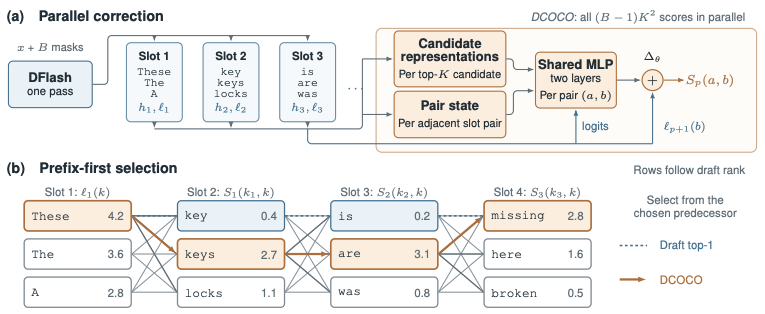
Diffusion-style drafters such as DFlash propose a whole block of tokens in a single pass, but each position is predicted without seeing which tokens were chosen before it. DCOCO keeps the top-16 candidates at every drafted position and scores how well each candidate fits each candidate at the next position, using candidate representations and a pair state over adjacent slots, all in one small batched pass. A prefix-first walk over those scores then picks the draft. This restores intra-block dependencies at a cost of a few percent of the drafting cycle.
| Target (verifier) model | Qwen/Qwen3-8B |
| Architecture | DCOCODraftModel: 5-layer DFlash drafter (hidden size 4096, bidirectional in-block attention) plus the DCOCO corrector |
| Corrector | K = 16 candidates per slot, candidate width 128, pair-state width 128, 2-layer scoring MLP (hidden 256); 2,229,505 parameters |
| Draft block | 15 drafted tokens per round (anchor position predicts); up to 16 tokens committed per verification |
| Target layers read | 1, 9, 17, 25, 33 |
| Training data | ~800K prompts from the stem, math and code splits of Nemotron Post-Training Dataset v2 and CodeAlpaca-20k, with continuations regenerated by Qwen/Qwen3-8B (greedy, thinking off, up to 4,096 tokens) |
| Training | 6 epochs of DFlash drafter training, then 6 epochs of joint training with the corrector; AdamW, lr 6e-4, cosine schedule |
| Format | BF16 safetensors (4.59 GB), vLLM-native config |
DCOCO runs in vLLM, through the speculative-decoding dflash method; vLLM selects the corrector
from the checkpoint's DCOCODraftModel architecture. This requires a vLLM build with DCOCO
support, such as the DCOCO image (vllm/vllm-openai:v0.31.0 with the DCOCO overlay).
vllm serve Qwen/Qwen3-8B \
  --speculative-config '{"method": "dflash", "model": "TD-Labs/Qwen3-8B-DCOCO", "num_speculative_tokens": 15}'
Check that the server log shows Resolved architecture: DCOCODraftModel. With any other
architecture, vLLM serves the drafter as plain DFlash without the corrector. Then query it like
any OpenAI-compatible server:
curl localhost:8000/v1/chat/completions -H 'content-type: application/json' -d '{
  "model": "Qwen/Qwen3-8B",
  "messages": [{"role": "user", "content": "How many positive whole-number divisors does 196 have?"}],
  "chat_template_kwargs": {"enable_thinking": false}
}'
num_speculative_tokens can be lowered (down to 1) but not raised above 15.
All results below are from the paper (Tables 1, 7, 8, 9 and 19). Setup: one NVIDIA B200 GPU, vLLM 0.27, concurrency 1 unless noted, thinking off with at most 2,048 generated tokens (4,096 with thinking on), 128 prompts per benchmark (all 30 of AIME-25, all 80 of MT-Bench, 880 of SPEED-Bench). Throughput (tok/s) is the median per-request rate (output tokens / request latency, including prefill); speedup is relative to the target model alone. τ is the mean accepted length per verification round, including the bonus token. T=0 is a single greedy run; T=1 is the mean over seeds 42, 43 and 44.
Greedy decoding (T=0) in the first four columns, sampling (T=1) in the last four.
| Benchmark | No-spec tok/s | DCOCO tok/s | Speedup | τ | No-spec tok/s | DCOCO tok/s | Speedup | τ |
|---|---|---|---|---|---|---|---|---|
| MATH-500 | 265.2 | 1625.2 | 6.13× | 8.039 | 264.5 | 1145.5 | 4.33× | 5.755 |
| AIME-25 | 263.7 | 1436.8 | 5.45× | 7.263 | 263.6 | 828.7 | 3.14× | 4.486 |
| GSM8K | 267.0 | 1175.8 | 4.40× | 6.118 | 266.4 | 1081.3 | 4.06× | 5.440 |
| HumanEval | 266.6 | 1075.6 | 4.03× | 5.443 | 266.4 | 910.0 | 3.42× | 4.646 |
| MBPP | 267.0 | 979.1 | 3.67× | 5.215 | 266.6 | 848.3 | 3.18× | 4.428 |
| LiveCodeBench | 264.2 | 1328.5 | 5.03× | 6.982 | 265.3 | 1013.7 | 3.82× | 5.431 |
| MT-Bench | 266.0 | 494.7 | 1.86× | 2.930 | 265.3 | 450.8 | 1.70× | 2.581 |
| Arena-Hard-v2 | 264.1 | 486.9 | 1.84× | 2.736 | 264.2 | 436.8 | 1.65× | 2.286 |
| Alpaca | 265.9 | 496.1 | 1.87× | 2.560 | 265.5 | 447.5 | 1.69× | 2.313 |
| SPEED-Bench | 266.5 | 498.4 | 1.87× | 2.561 | 266.2 | 459.5 | 1.73× | 2.373 |
| Average | 265.6 | 959.7 | 3.62× | 4.985 | 265.4 | 762.2 | 2.87× | 3.974 |
Thinking off:
| Method | tok/s (T=0) | Speedup (T=0) | τ (T=0) | tok/s (T=1) | Speedup (T=1) | τ (T=1) |
|---|---|---|---|---|---|---|
| DFlash | 783.1 | 2.95× | 3.913 | 649.8 | 2.45× | 3.259 |
| Domino | 839.3 | 3.16× | 4.613 | 670.9 | 2.53× | 3.697 |
| DSpark | 765.6 | 2.88× | 4.254 | 628.7 | 2.37× | 3.494 |
| DCOCO | 959.7 | 3.62× | 4.985 | 762.2 | 2.87× | 3.974 |
Thinking on (extended reasoning):
| Method | tok/s (T=0) | Speedup (T=0) | τ (T=0) | tok/s (T=1) | Speedup (T=1) | τ (T=1) |
|---|---|---|---|---|---|---|
| DFlash | 510.0 | 1.95× | 2.501 | 465.2 | 1.78× | 2.274 |
| Domino | 516.1 | 1.97× | 2.772 | 469.5 | 1.79× | 2.502 |
| DSpark | 480.6 | 1.83× | 2.595 | 438.9 | 1.68× | 2.364 |
| DCOCO | 592.5 | 2.26× | 2.999 | 530.4 | 2.03× | 2.677 |
Aggregate output tokens/s, averaged over the ten benchmarks.
| Concurrent requests | DFlash | Domino | DSpark | DCOCO | DCOCO vs. best other |
|---|---|---|---|---|---|
| 1 (T=0) | 783.1 | 839.3 | 765.6 | 959.7 | +14.3% |
| 4 (T=0) | 2806.4 | 3008.6 | 2719.0 | 3507.3 | +16.6% |
| 8 (T=0) | 4889.1 | 5051.0 | 4614.4 | 6082.6 | +20.4% |
| 16 (T=0) | 7229.1 | 7098.4 | 7092.9 | 8894.3 | +23.0% |
| 32 (T=0) | 9655.0 | 9013.9 | 9490.3 | 11512.4 | +19.2% |
| 1 (T=1) | 649.8 | 670.9 | 628.7 | 762.2 | +13.6% |
| 4 (T=1) | 2300.3 | 2334.1 | 2198.9 | 2710.0 | +16.1% |
| 8 (T=1) | 4006.3 | 3894.9 | 3758.1 | 4735.3 | +18.2% |
| 16 (T=1) | 5964.5 | 5441.1 | 5730.3 | 6871.9 | +15.2% |
| 32 (T=1) | 7857.9 | 6821.8 | 7443.4 | 8836.1 | +12.4% |
Qwen/Qwen3-8B and must be served with exactly that target model.@misc{eisenstadt2026contextualcorrectionparalleldrafts,
title={Contextual Correction of Parallel Drafts for Speculative Decoding},
author={Roy Eisenstadt and Harel Lidar and Tal Gonen and Omer Luxembourg and Itamar Zimerman and Lior Wolf and Eli David and Ilan Naiman},
year={2026},
eprint={2610.12570},
archivePrefix={arXiv},
primaryClass={cs.CL},
url={https://arxiv.org/abs/2610.12570},
}