

🇱🇰 SinhalaLM — Instruct
A fully fine-tuned, instruction-following Sinhala question-answering model
SinhalaLM-Instruct · by HelaAI





📑 Table of contents
- Overview
- Relationship to the base model
- Prompt template
- Architecture
- Fine-tuning
- How to use
- Intended use
- Limitations and biases
- Files in this repo
- License
- Citation
- Contact
🔎 Overview
SinhalaLM — Instruct is an instruction-tuned, question-answering variant of SinhalaLM, a GPT-style decoder-only transformer built from scratch for the Sinhala language. It combines the same core architectural ingredients as the base model — Rotary Position Embeddings (RoPE), SwiGLU gated feed-forward blocks, and a custom Sinhala byte-pair encoding (BPE) tokenizer — with full fine-tuning on a Sinhala question-answer dataset, so that every parameter in the model (not just a low-rank adapter subset) adapts to the instruction-following QA task.
Given a Sinhala question wrapped in a fixed instruction template, the model generates a Sinhala answer directly, without requiring any few-shot examples at inference time.
This is a custom architecture — it is not a standard transformers (AutoModel) class. The full model definition, tokenizer, and prompt-building utilities ship in this repository as modeling_sinhalalm.py and must be imported directly (see How to use below).
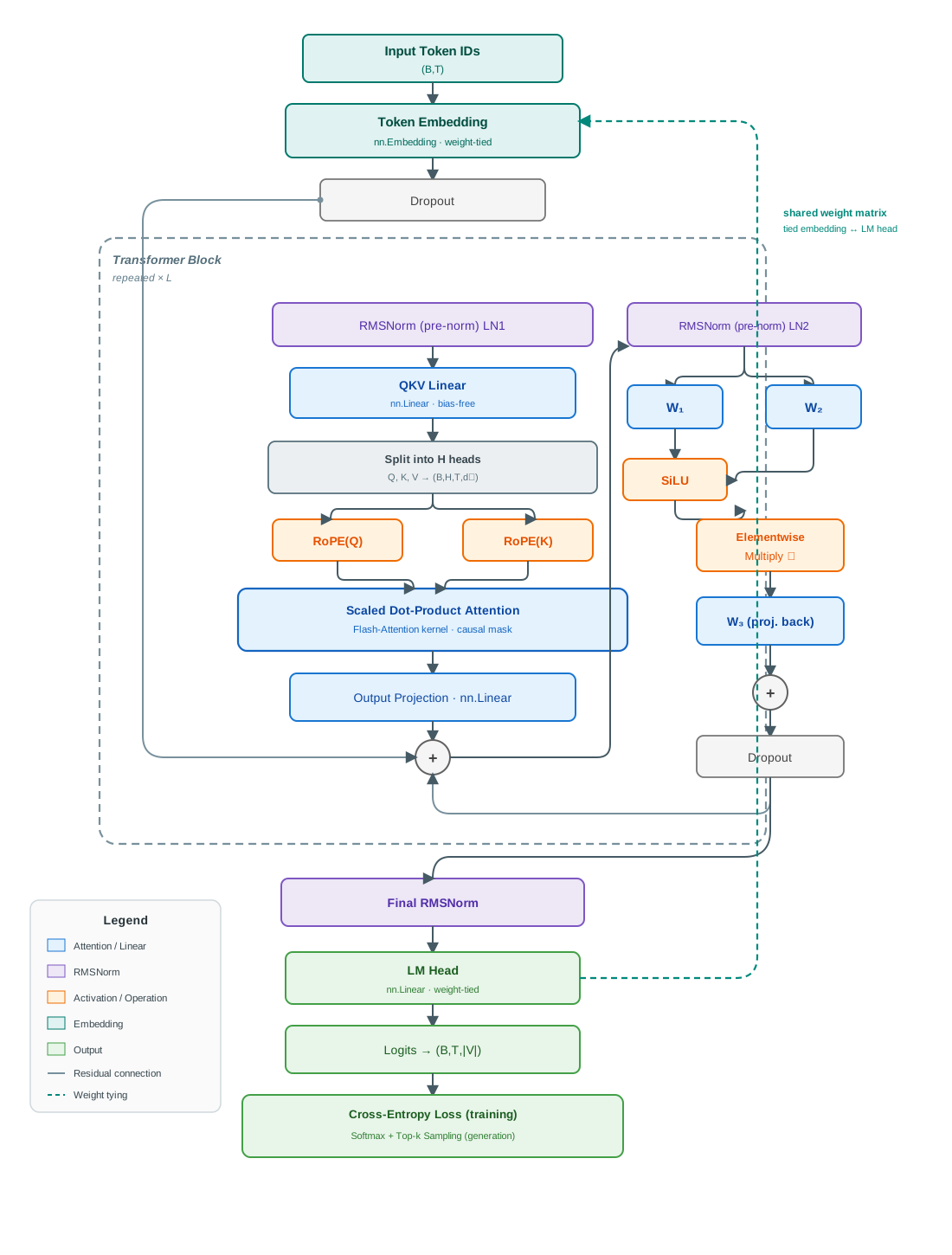
Detailed internal architecture of a single SinhalaLM decoder block — showing the QKV split, per-head RoPE application, the fused Flash-Attention kernel, both residual connections, and the SwiGLU feed-forward path with weight tying between the token embedding and the LM head. The same block design underlies both the base and instruct-tuned checkpoints.
⚠️ Private repository. Only Hugging Face accounts explicitly granted access can pull this repo. Do not share the access token.
🔗 Relationship to the base model
SinhalaLM — Instruct is obtained by fully fine-tuning the private base checkpoint ChamaraVishwajithRajapaksha/SinhalaLM-V.0.0.1 — a GPT-style Sinhala language model pretrained from scratch — on Sinhala question-answer data. "Full" fine-tuning means every weight in the network is updated during this stage, rather than freezing the backbone and training a small set of adapter parameters (e.g. LoRA). This is practical here specifically because the base model is small (tens of millions, not billions, of parameters), which keeps full fine-tuning affordable on a single GPU while still letting every layer specialize to the QA task.
| Base model | ChamaraVishwajithRajapaksha/SinhalaLM-V.0.0.1 |
| Adaptation method | Full fine-tuning (all parameters updated) |
| Task | Sinhala instruction-following question answering |
| Fine-tuning data | ChamaraVishwajithRajapaksha/sinhala-question-answer-pairs, ihalage/sinhala-finetune-qa-eli5 |
📝 Prompt template (Alpaca-style, Sinhala)
The model was fine-tuned on prompts built like this — use the exact same format at inference time, and stop generating at <EOS>:
පහත ප්රශ්නයට සිංහලෙන් පිළිතුරු දෙන්න.
### ප්රශ්නය:
<your question here>
### පිළිතුර:
<model completes from here>
Loss was masked during training so that only the answer tokens (after ### පිළිතුර:) contributed to the loss — the model was never trained to reproduce the question or the system instruction header, only to continue them with an appropriate answer.
🏗️ Architecture
SinhalaLM — Instruct inherits its decoder-only transformer architecture directly from the SinhalaLM base model.
| Component | Design choice |
|---|---|
| Parameters | ~44.7M |
| Embedding dim | 512 |
| Attention heads | 8 |
| Transformer layers | 8 |
| Context length | 512 tokens |
| Vocabulary size | 15,000 |
| Position encoding | Rotary (RoPE) |
| Feed-forward | SwiGLU (gated activation) |
| Normalization | RMSNorm (pre-norm) |
| Weight tying | Input token embedding tied to the output LM head |
Note: the instruct checkpoint's parameter count (
44.7M) is larger than the base model's (32.9M); the additional parameters come from task-specific components added during fine-tuning on top of the shared transformer backbone.
🎯 Fine-tuning
| Dataset | ChamaraVishwajithRajapaksha/sinhala-question-answer-pairs / ihalage/sinhala-finetune-qa-eli5 |
| Question column | input |
| Answer column | target |
| Adaptation method | Full fine-tuning (all parameters trainable) |
| Prompt template | Alpaca-style, Sinhala system header |
| Loss masking | Yes — answer tokens only |
| Training steps | 447 |
| Final train loss | 2.254163 |
| Final validation loss | 2.381392 |
| Best validation loss | 2.381392 |
| Best perplexity | 10.82 |
Full fine-tuning curves and a CSV/JSON breakdown are provided in analytics/. Example generations from the fine-tuning run are in sample_generations.txt (if included in this repo).
🚀 How to use
Install dependencies:
pip install torch huggingface_hub safetensors
Download, load, and ask a question:
from huggingface_hub import snapshot_download
import torch, json, sys
# 1. Download the repo (private — requires a token with read access)
local_dir = snapshot_download(repo_id="ChamaraVishwajithRajapaksha/SinhalaLM-V.0.0.1-it", token="YOUR_HF_TOKEN")
# 2. Import the model + tokenizer classes shipped in this repo
sys.path.insert(0, local_dir)
from modeling_sinhalalm import SinhalaGPT, FastBPETokenizer, build_prompt, get_prompt_prefix
# 3. Load config
config = json.load(open(f"{local_dir}/config.json"))
# 4. Load tokenizer
tokenizer = FastBPETokenizer.load(f"{local_dir}/bpe_vocabulary.json")
# 5. Build model + load fine-tuned weights
from safetensors.torch import load_file
state_dict = load_file(f"{local_dir}/model.safetensors")
model = SinhalaGPT(
vocab_size=config["vocab_size"],
embed_dim=config["n_embed"],
n_heads=config["n_heads"],
n_layers=config["n_layers"],
block_size=config["block_size"],
dropout=0.0, # no dropout at inference
)
model.load_state_dict(state_dict)
model.eval()
# 6. Ask a question using the exact fine-tuning prompt template
device = "cuda" if torch.cuda.is_available() else "cpu"
model.to(device)
question = "ශ්රී ලංකාවේ අගනුවර කුමක්ද?"
prefix = get_prompt_prefix(question)
ids = [tokenizer.stoi.get("<BOS>", 2)] + tokenizer.encode(prefix)
ctx = torch.tensor([ids], dtype=torch.long, device=device)
out = model.generate(ctx, max_new_tokens=200, temperature=0.7, top_k=50)
answer_ids = out[0, len(ids):].tolist()
print(tokenizer.decode(answer_ids))
Generation parameters
| Parameter | Effect |
|---|---|
temperature |
Lower (e.g. 0.5–0.7) → more focused, deterministic answers. Higher (e.g. 1.0+) → more varied/creative phrasing. |
top_k |
Restricts sampling to the k most likely tokens at each step. Lower = safer, less diverse. |
max_new_tokens |
Number of answer tokens to generate. Total context (prompt + answer) is capped at 512 tokens. |
⚠️ Always build the prompt with
get_prompt_prefix()(or the exact template shown above) — deviating from the fine-tuning prompt format will noticeably degrade answer quality, since the model was only trained to continue that specific structure.
🎯 Intended use
SinhalaLM — Instruct is intended for Sinhala question answering in research and prototyping contexts — e.g. exploring compact, from-scratch, instruction-tuned models for a low-resource language, or as a lightweight QA component in a larger Sinhala NLP pipeline.
Not intended for:
- ❌ Production deployment without further evaluation, safety review, and human oversight.
- ❌ High-stakes factual use (medical, legal, financial, or safety-critical questions) — answers are not verified or fact-checked.
- ❌ Multi-turn dialogue or open-ended chat — the model is fine-tuned specifically for single-turn question → answer completion in the prompt format above.
- ❌ Any use requiring inputs/outputs longer than 512 tokens total.
⚠️ Limitations and biases
- Fine-tuned on a relatively small QA dataset (447 training steps) — coverage of topics outside the fine-tuning distribution may be shallow or inaccurate.
- As with any fine-tuned language model, answers may be fluent but factually incorrect ("hallucinated") — always verify important claims independently.
- Inherits any biases present in both the base pretraining corpus and the QA fine-tuning data.
- Context window is limited to 512 tokens (prompt + answer combined).
- Strict reliance on the exact prompt template — inputs that deviate from the trained format may produce degraded or off-format answers.
- No safety filtering or content moderation has been applied to outputs.
- Monolingual (Sinhala) by design — not intended for multilingual or code-switched input.
📁 Files in this repo
| File | Description |
|---|---|
model.safetensors |
Fine-tuned model weights |
config.json |
Architecture + fine-tuning config |
bpe_vocabulary.json |
Full tokenizer (vocab + merges + priorities) — load with FastBPETokenizer.load(...) |
vocab.json, merges.txt, tokenizer.json, tokenizer_config.json, special_tokens_map.json |
HF-style tokenizer files (informational; the authoritative loader is FastBPETokenizer) |
modeling_sinhalalm.py |
Full source of the model, tokenizer, and prompt-template functions (SinhalaGPT, FastBPETokenizer, build_prompt, get_prompt_prefix) |
images/sinhalalm_detailed_architecture.svg |
Detailed architecture diagram of a single SinhalaLM decoder block |
sample_generations.txt |
Example Q&A generations from the fine-tuning run (if present) |
analytics/ |
Fine-tuning loss / validation / learning-rate / perplexity graphs, CSVs, and a text + JSON summary |
📜 License
This model is released under a custom/other license. Update this section with your actual terms (e.g. permitted uses, redistribution, commercial use) before granting access to others.
📚 Citation
If you use this model, please cite:
@misc{sinhalalminstruct,
  title  = {SinhalaLM -- Instruct},
  author = {Chamara Vishwajith and Dr. Kushan Sudheera and Dineth Jayakody},
  year   = {2026},
  note   = {Instruction-tuned, fully fine-tuned Sinhala question-answering model, built on the SinhalaLM base checkpoint}
}
📬 Contact
Developed by HelaAI. For questions or access requests, contact one of the authors of the base SinhalaLM model, or the repository owner on Hugging Face.
—— SinhalaLM · Instruct · HelaAI ——
- Downloads last month
- 74